
The Sentence
Your doctor visit concludes with a review of your less than optimal lab results. You brace yourself for the advice you know is coming, and it does, “You need to make some lifestyle changes.” The words, although spoken politely, land with the delicacy of a prison sentence.
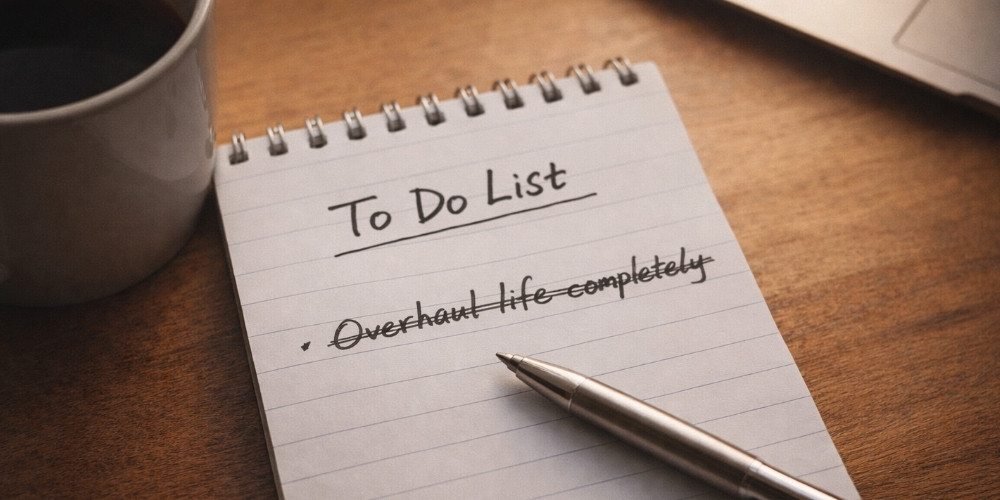
You nod attentively, but inside you’re translating: remove everything you like and enjoy and replace it with everything you don’t like or enjoy. Overhaul your entire existence. Become a different person.
You walk back to your car feeling dejected. Not excited. Not motivated.
No fun.
Makeover Takeover
You can’t be blamed for feeling this way. It’s overwhelming to feel like no matter how much you try, how much you change, it’ll never be enough.
The concept of “lifestyle change” is so big and monolithic that it seems like you’re expected to give up everything that makes you, you. It’s wholesale transformation. Join the gym, prep all your meals, budget every dollar, count your calories, and so on.
But that’s not what lifestyle change has to mean. Your lifestyle is simply a collection of your daily habits and routines. There’s nothing mystical about it. If you change a habit, and sustain it long enough, you’ve changed your lifestyle. Not a full makeover, just a touchup. But changed it, nonetheless.
Your lifestyle is simply a collection of your daily habits and routines. If you change a habit and sustain it long enough, you’ve changed your lifestyle.
Evolving Style
Consider your own personal style—the way you dress and present yourself. It’s an expression of who you are based on decades of experimenting and refinement. You don’t overhaul your wardrobe overnight. You gradually try new things.
Maybe you switch from button-downs to polos because they’re more comfortable. You start wearing darker colors. You get a different haircut. Each change is small, but collectively they shift your entire aesthetic.
Six months later, you look different—but you’re still you. Your essence hasn’t changed, just your expression.
Your lifestyle works the same way. It’s made up of countless small components: what time you go to bed, how often you look at your phone, whether or not you read, what and when you eat. Adjust any of the components, and you’ve altered the whole.
The trick? It has to be repeated enough to become part of your routine and not a one-off variation.
You don’t overhaul your wardrobe overnight. You gradually try new things. Your lifestyle works the same way.
From Variation to Routine
If you stretch for 5 minutes one morning, that’s a variation. Do it 5 days straight? That’s a trend. Keep it up for a month, now you’ve got a routine. If you stick with the routine for a few months, it’s just what you do. It’s not something you have to think about anymore, it’s part of your lifestyle.
Compare yourself to who you were 15 years ago and I’m sure you can identify countless differences: hobbies, books, foods.
But other than obvious inflection points, like having a child or moving to a new city, can you pinpoint where those changes happened? Many of them evolved slowly and gradually over time, eventually resulting in a nearly complete remodel of who you are.
You didn’t change overnight. New habits and routines replaced old ones that died off.
Shopping At the 7-11
If we embrace this interpretation of lifestyle change, then experimenting with it doesn’t have to be overwhelming, and can actually be fun. Your life becomes a low stakes experimentation lab for you to try different things and see what sticks.
Here’s a simple mental framework, we’ll call it 7-11—just like the convenience store. Except we’re going shopping for little variations that are easy to try out to see if we can turn them into routines.
Here’s how.
For the next seven days, pick one area of your life and try one new thing. Seven, one, one.
- Eating: add a small salad to your dinner plate
- Movement: do 20 squats while your coffee brews
- Sleep: read for 10 minutes before bed instead of scrolling
Not all three. Just one.
The only rule is that your new thing has to be something you judge to be an improvement. That’s it.
Why 7 days? It’s not a magic number, but it’s enough to decide if you want to keep going, or if it’s not going to work for you. You like it? Repeat another 7 days. You don’t? Pick something new.
The point is to repeat it enough to make your new variation a trend. If you like it, make the trend a routine. Before you know it, you will have made one, simple, durable lifestyle change.
Evolution, Not Revolution
We’re wired to resist change because our routines feel like part of our identity. And they are—but identity evolves. You’re not the same person you were 15 years ago, and you didn’t get here through wholesale transformation. So don’t demand if of yourself now.
You don’t need to battle all your bad habits at once. Just pick one small thing to try. See if you like it and keep it if it works. Turn a trend into a routine. That’s not deprivation—it’s evolution. And evolution is something you’re already doing, whether you realize it or not.
As always, thanks for reading. I’m truly happy you’re here.
All the best,
Nate